| Rope construction: 6x19 / 6x36 Group IWRC | |||||
| Size | Mass | 1770 Tensile Grade | 1960 Tensile Grade | ||
| mm | Kg/100m | MBL tonnes | MBF kN | MBL tonnes | MBF kN |
| 8 | 26,2 | 4,11 | 40,3 | 4,56 | 44,7 |
| 9 | 33,1 | 5,20 | 51,0 | 5,76 | 56,5 |
| 10 | 40,9 | 6,42 | 63,0 | 7,12 | 69,8 |
| 11 | 49,5 | 7,77 | 76,2 | 8,61 | 84,4 |
| 12 | 58,9 | 9,25 | 90,7 | 10,2 | 100 |
| 13 | 69,1 | 10,8 | 106 | 12,0 | 118 |
| 14 | 80,2 | 12,6 | 124 | 14,0 | 137 |
| 16 | 105 | 16,4 | 161 | 18,3 | 179 |
| 18 | 133 | 20,8 | 204 | 23,1 | 226 |
| 19 | 148 | 23,1 | 227 | 25,7 | 252 |
| 20 | 164 | 25,7 | 252 | 28,5 | 279 |
| 22 | 198 | 31,1 | 305 | 34,5 | 338 |
| 24 | 236 | 37,0 | 363 | 41,0 | 402 |
| 26 | 276 | 43,4 | 426 | 48,1 | 472 |
| 28 | 321 | 50,4 | 494 | 55,8 | 547 |
| 32 | 419 | 65,7 | 645 | 72,9 | 715 |
| 35 | 501 | 78,7 | 772 | 87,2 | 855 |
| 36 | 530 | 83,3 | 817 | 92,2 | 904 |
| 38 | 591 | 92,8 | 910 | 103,0 | 1 010 |
| 40 | 654 | 103 | 1 010 | 114,0 | 1 120 |
| Rope construction: 6x19 / 6x36 Group Fibre Core | |||||
| Size | Mass | 1770 Tensile Grade | 1960 Tensile Grade | ||
| mm | Kg/100m | MBL tonnes | MBF kN | MBL tonnes | MBF kN |
| 8 | 23,6 | 3,81 | 37,4 | 4,22 | 41,4 |
| 9 | 29,7 | 4,82 | 47,3 | 5,34 | 52,4 |
| 10 | 36,7 | 5,95 | 58,4 | 6,60 | 64,7 |
| 11 | 44,4 | 7,21 | 70,7 | 7,99 | 78,3 |
| 12 | 52,8 | 8,57 | 84,1 | 9,50 | 93,1 |
| 13 | 62,0 | 10,1 | 96,7 | 11,1 | 109 |
| 14 | 71,9 | 11,6 | 114 | 13,0 | 127 |
| 16 | 94,0 | 15,3 | 150 | 16,9 | 166 |
| 18 | 119 | 19,3 | 189 | 21,4 | 210 |
| 19 | 132 | 21,5 | 211 | 23,8 | 233 |
| 20 | 147 | 23,9 | 234 | 26,4 | 259 |
| 22 | 178 | 28,8 | 263 | 31,9 | 313 |
| 24 | 211 | 34,3 | 336 | 38,0 | 373 |
| 26 | 248 | 40,3 | 395 | 44,6 | 437 |
| 28 | 288 | 46,7 | 458 | 51,7 | 507 |
| 32 | 376 | 61,0 | 598 | 67,5 | 662 |
| 35 | 450 | 73,0 | 716 | 80,8 | 792 |
| 36 | 476 | 77,2 | 757 | 85,5 | 838 |
| 38 | 530 | 85,9 | 843 | 95,3 | 834 |
| 40 | 567 | 95,3 | 935 | 106,0 | 1 040 |
Monday, 16 May 2011
Steel wire rope weights and breaking load
Standard: BS EN 12385-4:2002

CLASSIFIED - put your ads on this blog

Friday, 6 May 2011
Ukrainian auto market in April 2011
As per the report of the Ukrainian agency AUTO-Consulting, in April 2011 the automotive market for the passenger and light commercial vehicles in Ukraine shows the stable upward dynamics.
Laut des Berichts von der ukrainischen Autoberatungsagentur AUTO-Consulting hat der PKW/Kleinttransporter-Markt in der Ukraine im April 2011 einen beständigen Zuwachs gezeigt.

It is worth mentioning the success of Hyundai making the 2nd place.
Das ist nennenswert den Erfog des koreanischen Herstellers Hyundai, der den 2. Platz erreicht, zu betonen.

Laut des Berichts von der ukrainischen Autoberatungsagentur AUTO-Consulting hat der PKW/Kleinttransporter-Markt in der Ukraine im April 2011 einen beständigen Zuwachs gezeigt.
It is worth mentioning the success of Hyundai making the 2nd place.
Das ist nennenswert den Erfog des koreanischen Herstellers Hyundai, der den 2. Platz erreicht, zu betonen.

CLASSIFIED - put your ads on this blog
Wednesday, 4 May 2011
Fresh Water Allowance (FWA) vs Dock Water Allowance (DWA)

Fresh Water Allowance (FWA) is the amount by which a ship's mean draft changes when she moves from the sea standard salt water (SW @ 1.025 t/m3) to fresh water (FW @ 1.000 t/m3).
FWA (in mm) = Displacement / (4 x TPC)
FWA (in cm) = Displacement / (40 x TPC)
FWA (in cm) = Displacement / (40 x TPC)
For box-shaped vessel FWA remains same at all drafts (as TPC remains constant), otherwise FWA increases with the draft (as TPC increases with the draft).
Dock Water Allowance (DWA) is the amount by which a ship's mean draft changes when she moves from the sea standard salt water (SW @ 1.025 t/m3) to dock water (DW @ various t/m3).
The formula that may be used is:
DWA = FWA * (1.025 – density of DW) / 0.025
Recently I found a meticulous video explanation on the topic. Tribute to the author of the video Capt. A.N. Rizvi.
CLASSIFIED - put your ads on this blog
Friday, 8 April 2011
Car carrier ports and hubs in Europe and wider Mediterranean
Our planet is encompassed by the trade flows which grew up from the caravan paths of anciency into the modern pattern of routes and act like blood vessels to the industrial society: instead of blood, in the literal sense, nations and communities get channelled food, water, equipment, materials, and other goods. Routes transport the blood of the Economy - values.
One type of the goods that concentrate in itself a pretty great value pro unit of mass is cars.
 |
| So many cars - so much value overseas (Newark, USA) |
Cars are not only valuable, they are also fascinating. Russian writer Nikolai Gogol wrote about addiction to speed when describing the national character of his compatriots. My own humble observations indicate that all people in the world are too much alike and definitely enjoy speeds more than that of a pedestrian. Moreover shiny and comfortable, powerful and technological means of transport and self-propelled power tools have always attracted us humans. So how do they get transported? The answer is by road, by rail, by air, and by sea.
 |
| Con-Ro ship loads Ro-Ro cargo (Bremerhaven, Germany) |
It is not surprising that the largest share in the transporting cars worldwide belongs to ships. The lowest cost per unit of a rolling-on rolling-of cargo (Ro-Ro) is achieved by utilising specialized Ro-Ro ships, particularly Pure Car-Truck Carriers (PCTC's), and specialized Ro-Ro terminals. The driving strive for the efficiency in the highly competitive environment has resulted in creating a net of dedicated port terminals and dry hubs. The Ro-Ro terminals are highly flexible or, I would say its the other way, mutable as they are often easily responsive to the fluctuations in the type of cargo. What remains more or less stable, it is the pattern of the channelling trade routes. This in its turn contributes to the relative stability of the main terminals' locations.
 |
| Bremerhaven is one of the largest auto hubs of the world |
For the subject region, Europe an wider Mediterranean, one could observe new emerging hubs and port terminals; though, many old places hold the grounds and remain stable. For a "car carrier man" the names would sound familiar:-
Mediterranean Sea:
Tartous
Beirut
Derince
Piraeus
Koper
Livorno
Genoa
Gioia Tauro
Sete
Tarragona
Barcelona
Alexandria
Tripoli
Casablanca
Northern Europe:
Immingham
Tilbury
Southampton
Antwerp
Rotterdam
Bremerhaven
Wallhamn
Le Havre
Malmo
Gothenborg
Hanko
Emden
Black Sea:
Illichivsk
Constanza
The list does not include many other smaller ports that serve for the automotive industry. As well as those involved in the container transport of vehicles, which became the trend recently.
A.O. Chepok

This text is licensed under a Creative Commons Attribution-NonCommercial-NoDerivs 3.0 Unported License.
CLASSIFIED - put your ads on this blog
Wednesday, 23 March 2011
"Mark V" type ro-ro's for Wallenius Wilhelmsen
| Type/Class | General Cargo Container Car Carrier RO/RO |
| Built | 2011-2013 by Mitsubishi Heavy Industries |
| LOA | 265 m |
| Ramp | SWL 500 mt |
| Decks | 9 + Wx deck |
CLASSIFIED - put your ads on this blog
W&W's Green Terminal project
"Castor Green Terminal" is a Zero Emissions ocean terminal for ro-ro services. Modern, lean, electric and attractive. With its breaking new vision optimized by Wallenius Wilhelmsen for the global vehicle supply chain.
CLASSIFIED - put your ads on this blog
Friday, 18 February 2011
'TIS Auto Terminal' project in port of Yuzhny
In 2007-2009 the leading Ukrainian private stevedoring company Transinvestservice Ltd. (TIS Ltd.) was pursuing a project of a Ro-Ro terminal in port of Yuzhny.
The main advantages of the project were the depths alongside, infrastructure benefits, substantial area prospects of the site, and the quality commitment of the private port operators. Behind this project there were the best professionals available with experience in Ro-Ro port operations in Ukraine as well as worldwide. I had an honour to be a part of that team as the Manager in charge of the terminal construction and set-up of the operations. Unfortunately in early 2009 the project got suspended and finally totally frozen due to the collapse of the automotive market.
Here you are I post the last presentations for the project as today the interest to the TIS Ro-Ro is reviving, although not in the cargo volumes that were reckoned on and with the other people at the backstage.
2009 presentations for TIS Auto Terminal (TIS Ltd, port of Yuzhny, Ukraine) in Russian and in English.
Презентации ТИС Авто Терминала (ООО "ТИС", порт Южный, Украина) 2009 года на русском и английском.
2009 TIS Auto Terminal Presentation En
2009 TIS Auto Terminal Presentation Ru
2009 TIS Auto Terminal (TransRussia) Ru
The main advantages of the project were the depths alongside, infrastructure benefits, substantial area prospects of the site, and the quality commitment of the private port operators. Behind this project there were the best professionals available with experience in Ro-Ro port operations in Ukraine as well as worldwide. I had an honour to be a part of that team as the Manager in charge of the terminal construction and set-up of the operations. Unfortunately in early 2009 the project got suspended and finally totally frozen due to the collapse of the automotive market.
Here you are I post the last presentations for the project as today the interest to the TIS Ro-Ro is reviving, although not in the cargo volumes that were reckoned on and with the other people at the backstage.
2009 presentations for TIS Auto Terminal (TIS Ltd, port of Yuzhny, Ukraine) in Russian and in English.
Презентации ТИС Авто Терминала (ООО "ТИС", порт Южный, Украина) 2009 года на русском и английском.
2009 TIS Auto Terminal Presentation En
2009 TIS Auto Terminal Presentation Ru
2009 TIS Auto Terminal (TransRussia) Ru
CLASSIFIED - put your ads on this blog
Tuesday, 15 February 2011
Magnus Effect 'E-Ship 1'
Ein seltsames Schiff lüft sich aus dem Nebel an der Emsmeldorf. Von weitem sieht es sich aus, als hätte es vier vier Schornsteine wie ein Dampfschiff. Doch die Entwickler des "E-Ship 1" nutzen einen noch viel interaktive Kraft - den Wind. Dieses weltweit einmalige Frachtschiff segelt.
Sprecher:
- Sicherlich sind das keine gewöhnlichen Segeln in kommenden Sinne, aber es sind Machinen, die Wind nutzen um den Schiff voran zu treiben. Also würdigt es daran Segeln bezeichnen.
Die Konstrukteure des "E-Ship 1" machen sich ein Phänomen zu nutzen, das bereits 1852 beschrieben und seinen Entdecker Heinrich Gustav Magnus genannt wurde. Die vier Zylinder werden durch Elektromotoren in Rotation versetzt. Der Windfeld wird auf einen Seite beschleunigt und darauf gegen der überliegenden Seite abgebremst. Dadurch entsteht eine Geschwindigkeitsdifferenz, die entsprechenden Strömungsgesetzen einen Druckunterschied der gibt. Und daraus entsteht dann eine Kraft, die quer zu Windrichtung wirkt. Die sogenannten Flettner-Rotoren des E-Schiffes. Ausgeklügelte Steuerungstechnik stellt das reibungslose Zusammenspiel von CD- und Konventionelle Antrieb sicher.
Bei der Konstruktion des Schiffes Propellers kommen die Ingenieure auf Know-How aus dem Bau von Windkraftanlagen zurückreichen. Die Ruderanlagen wurde wurde für die Fahrt unter Segeln optimiert.
Sprecher:
- Alles ist darauf abgestimmt möglich viel Energie einzusparen. Und das rein teoretische Potenzial betont er immer wieder licht irgendwo obgleich bei 50%.
Fahrtschiffe verbrauchen weltweit circa 200 Mill. Tonnen Öl pro Jahr. Das "E-Ship 1" ist ein erster Schritt auf dem Weg zu einer erfolgreicher Energie-Wende in der Schiffsfahrt.
The Flettner rotors of 'E-Ship 1' are 27-m high and 4-m in diameter each. They use wind energy to propel the ship and work on the the principle of Magnus effect described by Heinrich Gustav Magnus yet in 1852. The concept of the rotor was demonstrated by a German physicist Anton Flettner in 1924.
A spinning cylinder in a moving airstream creates a lateral force perpendicular to the direction of the airstream which, when used on ships, propels the ship to move forward. Though the main propulsion power source is the conventional diesel bi-plant, the Flettner rotors allow to save 30% on fuel consumption, especially effective in beam winds.
The owner of the "E-Ship 1", the German company Enercon GmbH, is one of the largest wind turbine manufacturer in world. They ordered the vessel for the worldwide transporting of their produce. First contract served by the ship is the Irish contract of Enercon, where it installs wind turbines at the sea-shelf wind farms. It is estimated that annually Enercon supplies up to 16000 turbines in 30 countries all over the globe.
Sprecher:
- Sicherlich sind das keine gewöhnlichen Segeln in kommenden Sinne, aber es sind Machinen, die Wind nutzen um den Schiff voran zu treiben. Also würdigt es daran Segeln bezeichnen.
Die Konstrukteure des "E-Ship 1" machen sich ein Phänomen zu nutzen, das bereits 1852 beschrieben und seinen Entdecker Heinrich Gustav Magnus genannt wurde. Die vier Zylinder werden durch Elektromotoren in Rotation versetzt. Der Windfeld wird auf einen Seite beschleunigt und darauf gegen der überliegenden Seite abgebremst. Dadurch entsteht eine Geschwindigkeitsdifferenz, die entsprechenden Strömungsgesetzen einen Druckunterschied der gibt. Und daraus entsteht dann eine Kraft, die quer zu Windrichtung wirkt. Die sogenannten Flettner-Rotoren des E-Schiffes. Ausgeklügelte Steuerungstechnik stellt das reibungslose Zusammenspiel von CD- und Konventionelle Antrieb sicher.
Bei der Konstruktion des Schiffes Propellers kommen die Ingenieure auf Know-How aus dem Bau von Windkraftanlagen zurückreichen. Die Ruderanlagen wurde wurde für die Fahrt unter Segeln optimiert.
Sprecher:
- Alles ist darauf abgestimmt möglich viel Energie einzusparen. Und das rein teoretische Potenzial betont er immer wieder licht irgendwo obgleich bei 50%.
Fahrtschiffe verbrauchen weltweit circa 200 Mill. Tonnen Öl pro Jahr. Das "E-Ship 1" ist ein erster Schritt auf dem Weg zu einer erfolgreicher Energie-Wende in der Schiffsfahrt.
 |
| 'E-Ship 1' in Emden (source General Anzeiger) |
| Type/Class | Gen.Cargo / GL Ro-Ro Ice E3 |
| Built | 02.08.2010 |
| Shipyard | Lindenau Werft, Kiel |
| GRT | 12,968 |
| DWT | 10,500 |
| Capacity | 20,580 m³ |
| LOA | 130.40 m |
| Breadth | 22.50 m |
| Draft | 9.30 m |
| Engine | 2 x 3,500 kW |
| Speed | 17.5 knots |
| Cargo gear | Stern ramp, 2 cranes SWL 80-120 mt |
| Owner | Enercon GmbH |
 |
| Alongside in Emden |
The Flettner rotors of 'E-Ship 1' are 27-m high and 4-m in diameter each. They use wind energy to propel the ship and work on the the principle of Magnus effect described by Heinrich Gustav Magnus yet in 1852. The concept of the rotor was demonstrated by a German physicist Anton Flettner in 1924.
 |
| The principle of Magnus effect |
 |
| "E-Ship 1" alongside for cargo ops (source MarineTraffic.com) |
CLASSIFIED - put your ads on this blog
Thursday, 3 February 2011
Оказание помощи моторной лодке «La_Cavernae»
Целью данного реферата является анализ действий судна по оказанию помощи/спасению на море и рассмотрен пример документального оформления подобных событий, которые не являются редкостью в районах плавания у побережья США, стран Латинской и Южной Америки. Рассматриваемый случай позволяет определить алгоритм действий команды мостика и капитана с точки зрения обеспечения должной безопасности (охраны) судна, минимизации возможных убытков, потери эксплуатационного времени или других коммерческих рисков.
Мой реферат, предоставленный на курсах повышения квалификации в 2011г.
Мой реферат, предоставленный на курсах повышения квалификации в 2011г.
CLASSIFIED - put your ads on this blog
What is inside a car carrier? Cars? - Vehicles!
Having served for several years on board car carrier vessels I feel puzzled when asked how it looks like inside such a ship. Perhaps as a huge parking lot??? The best answer gives a picture, especially as the below picture, which shows outside the ship all that gets inside in addition to nice "cuts" on the sides.
Then I suggest you have a look at the below pictures.
 |
| All that is outside goes inside - a huge sailing parking lot |
Then I suggest you have a look at the below pictures.
 |
| Deck 6 |
 |
| Deck 9 |
 | |
| Movable cardeck - Deck 10 |
 |
| Ready to go |
 |
| Driving out through the ramp |
CLASSIFIED - put your ads on this blog
Thursday, 27 January 2011
Vehicle accidents at the time of Break-out
Analysis conducted on board ships of a major world car carrier indicated a whole accident category - the break-out accidents, which happened frequently in the US and European ports.
Below figure depicts how the vehicle collision damage occurs during the break-out operation, i.e. when a vehicle is being driven out from a stack and to the opening of the designated slopeway. Usually such accidents occurred after two or three hours past the commencement of the cargo operations.
A driver may be compelled to make a large turning in order to make an easy approach to the slopes. During the attempt to break out the vehicle (marked with a star on the figure) is prone to hit another one moved out from the nearby stack in the hold.

The above situation clearly indicates the lack of coordination which is supposed to be done by the signalman and/or crew.
Countermeasures
For Signalman and Crew:
Below figure depicts how the vehicle collision damage occurs during the break-out operation, i.e. when a vehicle is being driven out from a stack and to the opening of the designated slopeway. Usually such accidents occurred after two or three hours past the commencement of the cargo operations.
A driver may be compelled to make a large turning in order to make an easy approach to the slopes. During the attempt to break out the vehicle (marked with a star on the figure) is prone to hit another one moved out from the nearby stack in the hold.

The above situation clearly indicates the lack of coordination which is supposed to be done by the signalman and/or crew.
Countermeasures
For Signalman and Crew:
- Stand ahead of passenger side of the vehicle.
- Checked the following at the break-out operation: the front wheels are straight, the driver’s hands are kept neutral position.
- Keep steering wheel straight unless the vehicles was moved well ahead (at least one car's length).
- Always follow the signalman's instruction - self-judgement is strictly prohibited.
Best practice
The most experienced driver(s), normally a foreman and his assistant, undertake(s) duty of breaking out the vehicles and positioning them just in front of the slope ready to be driven out by the next pack of riding drivers. Key is already inserted, electronic safety switch is turned off, car is ready to drive. Sometimes during high intensity operations, when it is safe to do so, the driver's door is left open as well.
CLASSIFIED - put your ads on this blog
Thursday, 13 January 2011
IMDG Code 2010 and transportation of vehicles by sea

UN 3166 Engines, internal combustion, flammable gas powered:
“Engine, Internal Combustion Or Vehicle, Flammable Gas Powered Or Vehicle, Flammable Liquid Powered Or Engine, Fuel Cell, Flammable Gas Powered Or Engine, Fuel Cell, Flammable Liquid Powered Or Vehicle, Fuel Cell, Flammable Gas Powered Or Vehicle, Fuel Cell, Flammable Liquid Powered.”
UN 3171 Battery-Powered Vehicle or Battery-Powered Equipment:
"Types of articles transported under this entry include vehicles or equipment powered by wet batteries, sodium batteries or lithium batteries with the batteries installed, such as electrically-powered cars, lawnmowers, wheelchairs and other mobility aids."
New special provisions related to the carriage of vehicles and engines:
"SP312. Vehicles or machinery powered by a fuel cell engine shall be consigned under the entries UN 3166 Vehicle, Fuel Cell, Flammable Gas Powered or UN 3166 Vehicle, Fuel Cell, Flammable Liquid Powered, or UN 3166 Engine, Fuel Cell, Flammable Gas Powered or UN 3166 Engine, Fuel Cell, Flammable Liquid Powered, as appropriate.
“These entries include hybrid electric vehicles powered by both a fuel cell and an internal combustion engine with wet batteries, sodium batteries or lithium batteries, transported with the battery(ies) installed.
“Other vehicles which contain an internal combustion engine shall be consigned under the entries UN 3166 Vehicle, Flammable Gas Powered Or UN 3166 Vehicle, Flammable Liquid Powered, as appropriate.
“These entries include hybrid electric vehicles powered by both an internal combustion engine and wet batteries, sodium batteries or lithium batteries, transported with the batteries installed.”
“SP961. Vehicles and equipment are not subject to the provisions of this Code if they are stowed on a roll-on/roll-off ship or in another cargo space designated by the Administration (flag State) as specifically designed and approved for the carriage of vehicles and equipment and there are no signs of leakage from the battery, engine, fuel cell, compressed gas cylinder or accumulator, or fuel tank when applicable.
“In addition, vehicles and equipment are not subject to the provisions of this Code if any of the following conditions are met:
1) The fuel tank(s) of the vehicle or equipment powered by a flammable liquid fuel is empty and installed batteries are protected from short circuit;
2) The fuel tank(s) of the vehicle or equipment powered by a flammable gas is emptied of liquefied or compressed gas, the positive pressure in the tank does not exceed 2 bar, the fuel shutoff or isolation valve is and secured, and installed batteries are protected from short circuit; or
3) The vehicle or equipment is solely powered by a wet or dry electric storage battery or a sodium battery, and the battery is protected from short circuit.
“SP 962. Vehicles or equipment powered by internal combustion engines, fuel cells or batteries not meeting the conditions of special provision 961 shall be assigned to class 9 and shall meet the following requirements:
1) Vehicles and equipment shall not show signs of leakage from batteries, engines, fuel cells, compressed gas cylinders or accumulators, or fuel tank(s) when applicable;
2) For flammable liquid powered vehicles and equipment, the fuel tank(s) containing the flammable liquid shall not be more than one-fourth full and in any case the flammable liquid shall not exceed 250l;
3) For flammable gas powered vehicles and equipment, the fuel shut-off valve of the fuel tank(s) shall be securely closed;
4) Installed batteries shall be protected from damage, short circuit and accidental activation during transport. Lithium ion or lithium metal batteries shall meet the requirements of the United Nations Manual of Tests and Criteria, Part III, subsection 38.3, unless otherwise approved by the competent authority; and
5) Dangerous goods required for the operation of the vehicle or equipment such as fire extinguishers, compressed gas accumulators, airbag inflators, etc, shall be securely mounted in the vehicle or equipment.
“The marking, labelling and placarding provisions of this Code shall not apply."
One could as well read more on Dangerous Goods on pages of Shashi Kallada's blog. Particularly his posts relevant to this one, namely: UN 3166 VEHICLE, Vehicle and Dangerous Goods, and 3166 Vehicle and Placarding.
New IMDG Code
2010 is available
at Amazon.com
2010 is available
at Amazon.com
CLASSIFIED - put your ads on this blog
Sunday, 9 January 2011
A vessel not under command

ColRegs, Rule 3 paragraph (f):
The term “vessel not under command” means a vessel which through some exceptional circumstance is unable to manoeuvre as required by these Rules and is therefore unable to keep out of the way of another vessel.
???
- a vessel which have had breakdown of her engine(s);
- a vessel which have had breakdown of her steering gear;
- a vessel which have lost a propeller;
- a vessel which have lost her rudder;
- a vessel with her anchor down but not holding;
- a vessel riding to anchor chains with anchors unshackled;
- a sailing vessel becalmed;
- a vessel affected in such an exceptional way by weather conditions, that she is unable to keep out of the way of another vessel by alteration of course and/or speed, thus justifying her showing of not under command signals.
With reference to "A Guide to the Collision Avoidance Rules" by A.N. Cockcroft and J.N.F. Lameijer.
CLASSIFIED - put your ads on this blog
Monday, 3 January 2011
CITY OF ST. PETERSBURG - it's a PCC
'CITY OF ST. PETERSBURG' is a new eco-friendly PCC with a spheroidal prow. This ship was built by Kyokuyo Shipyard Corporation of Japan in 2010. Ship sighted 22 December 2010 at Kanmon Strait, Japan. Photos and videos published by a Japanese blogger Yoshirou.
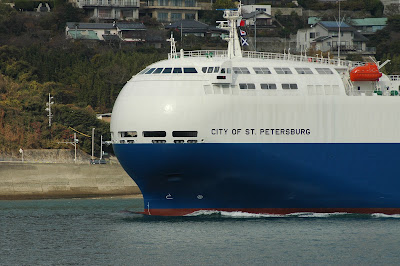
A 2000 CEU PCC is definitely fuel-efficient not only to cut running costs and reduce the environmental impact (cutting down fuel consumption by 800 tons or 2500 tons of CO2 per annum), but also to propagate its cargo - the electric vehicles Nissan Leaf.
Well done!

A 2000 CEU PCC is definitely fuel-efficient not only to cut running costs and reduce the environmental impact (cutting down fuel consumption by 800 tons or 2500 tons of CO2 per annum), but also to propagate its cargo - the electric vehicles Nissan Leaf.
Well done!
CLASSIFIED - put your ads on this blog
Subscribe to:
Posts (Atom)
Blog's Most Popular Posts last week
-
 Fresh Water Allowance (FWA) is the amount by which a ship's mean draft changes when she moves from the sea standard salt water (SW @...
 -
 Потребление бункера зависит от размера судна и его скорости. Для контейнеровозов в диапазоне от минимальных скоростей до 14 узлов эта завис...
 -
 Neither of the ISO 9001, 17001, 19011 standards define the validity period of the certificates for internal auditors. There is an opinion th...
 -
 Pipe description ++++++++++++++++++++++++++++++ Pipes are described by nominal size (e.g. 125A), which refers to and approximately matches ...
 -
Having been always an eager student myself and using the opportunity that at present I am lecturing in Maritime Transport Management at Odes...
-
Wellness, health, sports sound very positive to me. Looking at these words through the eye-glasses of my experience I commented the below po...
-
 I have received the following msg from a ship: Good afternoon , the ship drifting in the South China Sea, the crew is divided opinio...
 -
 T ahara, Toyohashi, prefecture of Aichi, Japan - this is the address of Lexus or Toyota may be coming from. Thousands of Toyotas and Lexus...
 -
 Российский Речной Регистр (РРР) Л Легкий (для плавания на малых реках, в верховьях крупных рек при высоте волны до 0.6 метра) Р Ре...


