| Type/Class | General Cargo Container Car Carrier RO/RO |
| Built | 2011-2013 by Mitsubishi Heavy Industries |
| LOA | 265 m |
| Ramp | SWL 500 mt |
| Decks | 9 + Wx deck |
Wednesday, 23 March 2011
"Mark V" type ro-ro's for Wallenius Wilhelmsen

CLASSIFIED - put your ads on this blog

W&W's Green Terminal project
"Castor Green Terminal" is a Zero Emissions ocean terminal for ro-ro services. Modern, lean, electric and attractive. With its breaking new vision optimized by Wallenius Wilhelmsen for the global vehicle supply chain.
CLASSIFIED - put your ads on this blog
Friday, 18 February 2011
'TIS Auto Terminal' project in port of Yuzhny
In 2007-2009 the leading Ukrainian private stevedoring company Transinvestservice Ltd. (TIS Ltd.) was pursuing a project of a Ro-Ro terminal in port of Yuzhny.
The main advantages of the project were the depths alongside, infrastructure benefits, substantial area prospects of the site, and the quality commitment of the private port operators. Behind this project there were the best professionals available with experience in Ro-Ro port operations in Ukraine as well as worldwide. I had an honour to be a part of that team as the Manager in charge of the terminal construction and set-up of the operations. Unfortunately in early 2009 the project got suspended and finally totally frozen due to the collapse of the automotive market.
Here you are I post the last presentations for the project as today the interest to the TIS Ro-Ro is reviving, although not in the cargo volumes that were reckoned on and with the other people at the backstage.
2009 presentations for TIS Auto Terminal (TIS Ltd, port of Yuzhny, Ukraine) in Russian and in English.
Презентации ТИС Авто Терминала (ООО "ТИС", порт Южный, Украина) 2009 года на русском и английском.
2009 TIS Auto Terminal Presentation En
2009 TIS Auto Terminal Presentation Ru
2009 TIS Auto Terminal (TransRussia) Ru
The main advantages of the project were the depths alongside, infrastructure benefits, substantial area prospects of the site, and the quality commitment of the private port operators. Behind this project there were the best professionals available with experience in Ro-Ro port operations in Ukraine as well as worldwide. I had an honour to be a part of that team as the Manager in charge of the terminal construction and set-up of the operations. Unfortunately in early 2009 the project got suspended and finally totally frozen due to the collapse of the automotive market.
Here you are I post the last presentations for the project as today the interest to the TIS Ro-Ro is reviving, although not in the cargo volumes that were reckoned on and with the other people at the backstage.
2009 presentations for TIS Auto Terminal (TIS Ltd, port of Yuzhny, Ukraine) in Russian and in English.
Презентации ТИС Авто Терминала (ООО "ТИС", порт Южный, Украина) 2009 года на русском и английском.
2009 TIS Auto Terminal Presentation En
2009 TIS Auto Terminal Presentation Ru
2009 TIS Auto Terminal (TransRussia) Ru
CLASSIFIED - put your ads on this blog
Tuesday, 15 February 2011
Magnus Effect 'E-Ship 1'
Ein seltsames Schiff lüft sich aus dem Nebel an der Emsmeldorf. Von weitem sieht es sich aus, als hätte es vier vier Schornsteine wie ein Dampfschiff. Doch die Entwickler des "E-Ship 1" nutzen einen noch viel interaktive Kraft - den Wind. Dieses weltweit einmalige Frachtschiff segelt.
Sprecher:
- Sicherlich sind das keine gewöhnlichen Segeln in kommenden Sinne, aber es sind Machinen, die Wind nutzen um den Schiff voran zu treiben. Also würdigt es daran Segeln bezeichnen.
Die Konstrukteure des "E-Ship 1" machen sich ein Phänomen zu nutzen, das bereits 1852 beschrieben und seinen Entdecker Heinrich Gustav Magnus genannt wurde. Die vier Zylinder werden durch Elektromotoren in Rotation versetzt. Der Windfeld wird auf einen Seite beschleunigt und darauf gegen der überliegenden Seite abgebremst. Dadurch entsteht eine Geschwindigkeitsdifferenz, die entsprechenden Strömungsgesetzen einen Druckunterschied der gibt. Und daraus entsteht dann eine Kraft, die quer zu Windrichtung wirkt. Die sogenannten Flettner-Rotoren des E-Schiffes. Ausgeklügelte Steuerungstechnik stellt das reibungslose Zusammenspiel von CD- und Konventionelle Antrieb sicher.
Bei der Konstruktion des Schiffes Propellers kommen die Ingenieure auf Know-How aus dem Bau von Windkraftanlagen zurückreichen. Die Ruderanlagen wurde wurde für die Fahrt unter Segeln optimiert.
Sprecher:
- Alles ist darauf abgestimmt möglich viel Energie einzusparen. Und das rein teoretische Potenzial betont er immer wieder licht irgendwo obgleich bei 50%.
Fahrtschiffe verbrauchen weltweit circa 200 Mill. Tonnen Öl pro Jahr. Das "E-Ship 1" ist ein erster Schritt auf dem Weg zu einer erfolgreicher Energie-Wende in der Schiffsfahrt.
The Flettner rotors of 'E-Ship 1' are 27-m high and 4-m in diameter each. They use wind energy to propel the ship and work on the the principle of Magnus effect described by Heinrich Gustav Magnus yet in 1852. The concept of the rotor was demonstrated by a German physicist Anton Flettner in 1924.
A spinning cylinder in a moving airstream creates a lateral force perpendicular to the direction of the airstream which, when used on ships, propels the ship to move forward. Though the main propulsion power source is the conventional diesel bi-plant, the Flettner rotors allow to save 30% on fuel consumption, especially effective in beam winds.
The owner of the "E-Ship 1", the German company Enercon GmbH, is one of the largest wind turbine manufacturer in world. They ordered the vessel for the worldwide transporting of their produce. First contract served by the ship is the Irish contract of Enercon, where it installs wind turbines at the sea-shelf wind farms. It is estimated that annually Enercon supplies up to 16000 turbines in 30 countries all over the globe.
Sprecher:
- Sicherlich sind das keine gewöhnlichen Segeln in kommenden Sinne, aber es sind Machinen, die Wind nutzen um den Schiff voran zu treiben. Also würdigt es daran Segeln bezeichnen.
Die Konstrukteure des "E-Ship 1" machen sich ein Phänomen zu nutzen, das bereits 1852 beschrieben und seinen Entdecker Heinrich Gustav Magnus genannt wurde. Die vier Zylinder werden durch Elektromotoren in Rotation versetzt. Der Windfeld wird auf einen Seite beschleunigt und darauf gegen der überliegenden Seite abgebremst. Dadurch entsteht eine Geschwindigkeitsdifferenz, die entsprechenden Strömungsgesetzen einen Druckunterschied der gibt. Und daraus entsteht dann eine Kraft, die quer zu Windrichtung wirkt. Die sogenannten Flettner-Rotoren des E-Schiffes. Ausgeklügelte Steuerungstechnik stellt das reibungslose Zusammenspiel von CD- und Konventionelle Antrieb sicher.
Bei der Konstruktion des Schiffes Propellers kommen die Ingenieure auf Know-How aus dem Bau von Windkraftanlagen zurückreichen. Die Ruderanlagen wurde wurde für die Fahrt unter Segeln optimiert.
Sprecher:
- Alles ist darauf abgestimmt möglich viel Energie einzusparen. Und das rein teoretische Potenzial betont er immer wieder licht irgendwo obgleich bei 50%.
Fahrtschiffe verbrauchen weltweit circa 200 Mill. Tonnen Öl pro Jahr. Das "E-Ship 1" ist ein erster Schritt auf dem Weg zu einer erfolgreicher Energie-Wende in der Schiffsfahrt.
 |
| 'E-Ship 1' in Emden (source General Anzeiger) |
| Type/Class | Gen.Cargo / GL Ro-Ro Ice E3 |
| Built | 02.08.2010 |
| Shipyard | Lindenau Werft, Kiel |
| GRT | 12,968 |
| DWT | 10,500 |
| Capacity | 20,580 m³ |
| LOA | 130.40 m |
| Breadth | 22.50 m |
| Draft | 9.30 m |
| Engine | 2 x 3,500 kW |
| Speed | 17.5 knots |
| Cargo gear | Stern ramp, 2 cranes SWL 80-120 mt |
| Owner | Enercon GmbH |
 |
| Alongside in Emden |
The Flettner rotors of 'E-Ship 1' are 27-m high and 4-m in diameter each. They use wind energy to propel the ship and work on the the principle of Magnus effect described by Heinrich Gustav Magnus yet in 1852. The concept of the rotor was demonstrated by a German physicist Anton Flettner in 1924.
 |
| The principle of Magnus effect |
 |
| "E-Ship 1" alongside for cargo ops (source MarineTraffic.com) |
CLASSIFIED - put your ads on this blog
Thursday, 3 February 2011
Оказание помощи моторной лодке «La_Cavernae»
Целью данного реферата является анализ действий судна по оказанию помощи/спасению на море и рассмотрен пример документального оформления подобных событий, которые не являются редкостью в районах плавания у побережья США, стран Латинской и Южной Америки. Рассматриваемый случай позволяет определить алгоритм действий команды мостика и капитана с точки зрения обеспечения должной безопасности (охраны) судна, минимизации возможных убытков, потери эксплуатационного времени или других коммерческих рисков.
Мой реферат, предоставленный на курсах повышения квалификации в 2011г.
Мой реферат, предоставленный на курсах повышения квалификации в 2011г.
CLASSIFIED - put your ads on this blog
What is inside a car carrier? Cars? - Vehicles!
Having served for several years on board car carrier vessels I feel puzzled when asked how it looks like inside such a ship. Perhaps as a huge parking lot??? The best answer gives a picture, especially as the below picture, which shows outside the ship all that gets inside in addition to nice "cuts" on the sides.
Then I suggest you have a look at the below pictures.

 |
| All that is outside goes inside - a huge sailing parking lot |
Then I suggest you have a look at the below pictures.
 |
| Deck 6 |
 |
| Deck 9 |
 | |
| Movable cardeck - Deck 10 |
 |
| Ready to go |
 |
| Driving out through the ramp |

CLASSIFIED - put your ads on this blog
Thursday, 27 January 2011
Vehicle accidents at the time of Break-out
Analysis conducted on board ships of a major world car carrier indicated a whole accident category - the break-out accidents, which happened frequently in the US and European ports.
Below figure depicts how the vehicle collision damage occurs during the break-out operation, i.e. when a vehicle is being driven out from a stack and to the opening of the designated slopeway. Usually such accidents occurred after two or three hours past the commencement of the cargo operations.
A driver may be compelled to make a large turning in order to make an easy approach to the slopes. During the attempt to break out the vehicle (marked with a star on the figure) is prone to hit another one moved out from the nearby stack in the hold.

The above situation clearly indicates the lack of coordination which is supposed to be done by the signalman and/or crew.
Countermeasures
For Signalman and Crew:
Below figure depicts how the vehicle collision damage occurs during the break-out operation, i.e. when a vehicle is being driven out from a stack and to the opening of the designated slopeway. Usually such accidents occurred after two or three hours past the commencement of the cargo operations.
A driver may be compelled to make a large turning in order to make an easy approach to the slopes. During the attempt to break out the vehicle (marked with a star on the figure) is prone to hit another one moved out from the nearby stack in the hold.

The above situation clearly indicates the lack of coordination which is supposed to be done by the signalman and/or crew.
Countermeasures
For Signalman and Crew:
- Stand ahead of passenger side of the vehicle.
- Checked the following at the break-out operation: the front wheels are straight, the driver’s hands are kept neutral position.
- Keep steering wheel straight unless the vehicles was moved well ahead (at least one car's length).
- Always follow the signalman's instruction - self-judgement is strictly prohibited.
Best practice
The most experienced driver(s), normally a foreman and his assistant, undertake(s) duty of breaking out the vehicles and positioning them just in front of the slope ready to be driven out by the next pack of riding drivers. Key is already inserted, electronic safety switch is turned off, car is ready to drive. Sometimes during high intensity operations, when it is safe to do so, the driver's door is left open as well.
CLASSIFIED - put your ads on this blog
Thursday, 13 January 2011
IMDG Code 2010 and transportation of vehicles by sea

UN 3166 Engines, internal combustion, flammable gas powered:
“Engine, Internal Combustion Or Vehicle, Flammable Gas Powered Or Vehicle, Flammable Liquid Powered Or Engine, Fuel Cell, Flammable Gas Powered Or Engine, Fuel Cell, Flammable Liquid Powered Or Vehicle, Fuel Cell, Flammable Gas Powered Or Vehicle, Fuel Cell, Flammable Liquid Powered.”
UN 3171 Battery-Powered Vehicle or Battery-Powered Equipment:
"Types of articles transported under this entry include vehicles or equipment powered by wet batteries, sodium batteries or lithium batteries with the batteries installed, such as electrically-powered cars, lawnmowers, wheelchairs and other mobility aids."
New special provisions related to the carriage of vehicles and engines:
"SP312. Vehicles or machinery powered by a fuel cell engine shall be consigned under the entries UN 3166 Vehicle, Fuel Cell, Flammable Gas Powered or UN 3166 Vehicle, Fuel Cell, Flammable Liquid Powered, or UN 3166 Engine, Fuel Cell, Flammable Gas Powered or UN 3166 Engine, Fuel Cell, Flammable Liquid Powered, as appropriate.
“These entries include hybrid electric vehicles powered by both a fuel cell and an internal combustion engine with wet batteries, sodium batteries or lithium batteries, transported with the battery(ies) installed.
“Other vehicles which contain an internal combustion engine shall be consigned under the entries UN 3166 Vehicle, Flammable Gas Powered Or UN 3166 Vehicle, Flammable Liquid Powered, as appropriate.
“These entries include hybrid electric vehicles powered by both an internal combustion engine and wet batteries, sodium batteries or lithium batteries, transported with the batteries installed.”
“SP961. Vehicles and equipment are not subject to the provisions of this Code if they are stowed on a roll-on/roll-off ship or in another cargo space designated by the Administration (flag State) as specifically designed and approved for the carriage of vehicles and equipment and there are no signs of leakage from the battery, engine, fuel cell, compressed gas cylinder or accumulator, or fuel tank when applicable.
“In addition, vehicles and equipment are not subject to the provisions of this Code if any of the following conditions are met:
1) The fuel tank(s) of the vehicle or equipment powered by a flammable liquid fuel is empty and installed batteries are protected from short circuit;
2) The fuel tank(s) of the vehicle or equipment powered by a flammable gas is emptied of liquefied or compressed gas, the positive pressure in the tank does not exceed 2 bar, the fuel shutoff or isolation valve is and secured, and installed batteries are protected from short circuit; or
3) The vehicle or equipment is solely powered by a wet or dry electric storage battery or a sodium battery, and the battery is protected from short circuit.
“SP 962. Vehicles or equipment powered by internal combustion engines, fuel cells or batteries not meeting the conditions of special provision 961 shall be assigned to class 9 and shall meet the following requirements:
1) Vehicles and equipment shall not show signs of leakage from batteries, engines, fuel cells, compressed gas cylinders or accumulators, or fuel tank(s) when applicable;
2) For flammable liquid powered vehicles and equipment, the fuel tank(s) containing the flammable liquid shall not be more than one-fourth full and in any case the flammable liquid shall not exceed 250l;
3) For flammable gas powered vehicles and equipment, the fuel shut-off valve of the fuel tank(s) shall be securely closed;
4) Installed batteries shall be protected from damage, short circuit and accidental activation during transport. Lithium ion or lithium metal batteries shall meet the requirements of the United Nations Manual of Tests and Criteria, Part III, subsection 38.3, unless otherwise approved by the competent authority; and
5) Dangerous goods required for the operation of the vehicle or equipment such as fire extinguishers, compressed gas accumulators, airbag inflators, etc, shall be securely mounted in the vehicle or equipment.
“The marking, labelling and placarding provisions of this Code shall not apply."
One could as well read more on Dangerous Goods on pages of Shashi Kallada's blog. Particularly his posts relevant to this one, namely: UN 3166 VEHICLE, Vehicle and Dangerous Goods, and 3166 Vehicle and Placarding.
New IMDG Code
2010 is available
at Amazon.com
2010 is available
at Amazon.com
CLASSIFIED - put your ads on this blog
Sunday, 9 January 2011
A vessel not under command

ColRegs, Rule 3 paragraph (f):
The term “vessel not under command” means a vessel which through some exceptional circumstance is unable to manoeuvre as required by these Rules and is therefore unable to keep out of the way of another vessel.
???
- a vessel which have had breakdown of her engine(s);
- a vessel which have had breakdown of her steering gear;
- a vessel which have lost a propeller;
- a vessel which have lost her rudder;
- a vessel with her anchor down but not holding;
- a vessel riding to anchor chains with anchors unshackled;
- a sailing vessel becalmed;
- a vessel affected in such an exceptional way by weather conditions, that she is unable to keep out of the way of another vessel by alteration of course and/or speed, thus justifying her showing of not under command signals.
With reference to "A Guide to the Collision Avoidance Rules" by A.N. Cockcroft and J.N.F. Lameijer.
CLASSIFIED - put your ads on this blog
Monday, 3 January 2011
CITY OF ST. PETERSBURG - it's a PCC
'CITY OF ST. PETERSBURG' is a new eco-friendly PCC with a spheroidal prow. This ship was built by Kyokuyo Shipyard Corporation of Japan in 2010. Ship sighted 22 December 2010 at Kanmon Strait, Japan. Photos and videos published by a Japanese blogger Yoshirou.
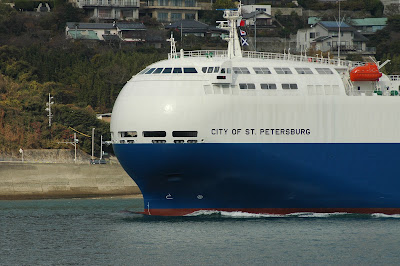
A 2000 CEU PCC is definitely fuel-efficient not only to cut running costs and reduce the environmental impact (cutting down fuel consumption by 800 tons or 2500 tons of CO2 per annum), but also to propagate its cargo - the electric vehicles Nissan Leaf.
Well done!

A 2000 CEU PCC is definitely fuel-efficient not only to cut running costs and reduce the environmental impact (cutting down fuel consumption by 800 tons or 2500 tons of CO2 per annum), but also to propagate its cargo - the electric vehicles Nissan Leaf.
Well done!
CLASSIFIED - put your ads on this blog
Thursday, 30 December 2010
Отображение параметров посадки, остойчивости и общей продольной прочности
Приведено описание модуля грузовой программы судна, который производит отображение параметров посадки, остойчивости и общей продольной прочности.
Моя статья в сборнике "Судовождение" №19, 2010.
Моя статья в сборнике "Судовождение" №19, 2010.
CLASSIFIED - put your ads on this blog
Sunday, 26 December 2010
The concept of a future cruise ship
In a few years we may see the type of cruise ships that implement "groundbreaking" technologies. Such a ship is presented below:
CLASSIFIED - put your ads on this blog
Friday, 17 December 2010
Natural Coolant for the Reefer-containers
As per announcement by Carrier Transicold, industry has recently got CO2 as the new "environment-friendlier" refrigerant to be used in the reefer-container temperature control systems. It is not about the natural CO2-based refrigerant medium R-744, but also about the new refrigeration-unit design.
Benefits of R-744 are:
Carrier Transicold, a company pioneering the technology, is shortly launching the full scale trials of the systems.
 |
| Photo by www.container.carrier.com |
Benefits of R-744 are:
- non-ozone depleting medium
- global warming potential (GWP) of 1 score, while the synthetic coolant R134a has GWP of 1320, R404a - of 3260
- CO2 used is the gas retrieved from the atmosphere, thus not adding to the environmental hazards if leaked out
- more efficient heat transfer
- power efficient inverter-type fan and compressor control
Carrier Transicold, a company pioneering the technology, is shortly launching the full scale trials of the systems.
CLASSIFIED - put your ads on this blog
Wednesday, 15 December 2010
Third officer’s common challenges onboard
- Joining the ship
- Watchkeeping
- GMDSS
- Navigation
- Paperwork on Arrival/Departure
- LSA/FFE
- Training & records
In order to prepare himself for smooth and successful career start-up, prior his first joining a ship in a new management company, a 3/O can have readied himself with the help of the following milestones:
Joining the ship
- Reporting to Master, presenting own papers - papers ready
- Taking over from previous 3rd officer LSA/FFE, paperwork, etc. - list of questions ready, not to forget to check the computer folder, take access passwords for PC’s, files, planned maintenance program (PMS), etc.
- Bridge controls familiarisation, departure duties - control test, checklists, equipment controls, flags, lights, shapes
- Preparing departure Crew List and other departure papers - files on PC, number of copies required, new crew documents, make with off-signing 3/O if appropriate
- Standard familiarisation with the ship after the takeover - familiarisation booklet
Watchkeeping
- Regulations - to know by heart STCW on watchkeeping at Sea, STCW on watchkeeping in Port, Collision Regulations, Lights & Shapes
- Procedures - check-lists from Bridge Procedures Guide, arrival/departure bridge control tests
- Chartwork and daily logbook entries - what to log, how to log
- Equipment - most important Autopilot (Steering), Radar, VHF, Sat-C, AIS, GPS receiver, Echosounder
GMDSS
- GMDSS log entries - have templates
- Tests on GMDSS equipment - how to do and to log
- Emergency procedures - how to perform and record during drills
Navigation
- Correction books - ALRS, ATT, ALL
- Correction charts - Temporary and Preliminary, NAVAREA & Navtex
- Gyro Compass Error - how to calculate the error by stars, Sun, Polar
- AMVER or similar reports - how to compile, how to submit
Paperwork on Arrival/Departure
- Papers - Crew List, Health Declaration, Declaration of Security, Crew Effects declaration, Ship Stores declaration, etc., specifics in USA, EU
- Advanced notifications (electronic submissions) - procedures and interface for the USA, EU, Singapore, etc. prior arrival
- Ship’s Documents and certificates - knowledge of the documents
- Computer literacy - formatting and printing out in Word, Excel
LSA/FFE
- LSA/FFE characteristics and requirements - SOLAS III (equipment requirements), LSA Code
- LSA/FFE - application procedures, maintenance procedures
- SCABA - application procedures, maintenance procedures
Training and records
- Emergency drills records - knowledge of the emergency procedures and drill scenarious, logbook records as per SOLAS/CFR/National requirements
- Training - CBT/VideoTel, record keeping in training books
A.O. Chepok

This text is licensed under a Creative Commons Attribution-NonCommercial-NoDerivs 3.0 Unported License.
CLASSIFIED - put your ads on this blog
Monday, 13 December 2010
Vessel propelled by machinery or vessel under oars?
Could anyone provide an answer if the below examples could be considered as examples of the power-driven vessels or vessels under oars (for the pure sake of Rule 25 of course!)
What about taking all her way off by stopping or reversing her means of propulsion??!
What about taking all her way off by stopping or reversing her means of propulsion??!
CLASSIFIED - put your ads on this blog
Wednesday, 1 December 2010
Моделирование укладки генеральных грузов в грузовые помещения судна
Приведено описание имитационной программы, которая отображает укладку генеральных грузов в грузовые помещения судна.
Моя статья в сборнике "Судовождение" №18, 2010.
Моя статья в сборнике "Судовождение" №18, 2010.
CLASSIFIED - put your ads on this blog
Wednesday, 24 November 2010
About Continuing Professional Development (CPD)
There is an opinion growing ever strong that the responsibility for training and for the maintenance of skills and the knowledge up-to-date lies with the individual seafarer.
"As part of continuing professional development (CPD) it is proposed to place the onus on individuals to ensure that they are competent in operating the equipment under their direction and provide the mechanism for them to achieve this." Harry Gale (Nautical Institute).
So what is the CPD? Here is what Wikipedia says on it.
"As part of continuing professional development (CPD) it is proposed to place the onus on individuals to ensure that they are competent in operating the equipment under their direction and provide the mechanism for them to achieve this." Harry Gale (Nautical Institute).
So what is the CPD? Here is what Wikipedia says on it.
Continuing Professional Development (CPD) can be defined as the conscious updating of professional knowledge and the improvement of professional competence throughout a person's working life. It is a commitment to being professional, keeping up to date and continuously seeking to improve. It is the key to optimizing a person's career opportunities, both today and for the future (Chartered Institute of Personnel and Development (2000)).
CPD should be engaging, informative and progressive, embracing 'best practice' and easily digestible knowledge. It should neither be excessively demanding nor uninteresting. It should stimulate a desire to learn more about your profession and participate in it (The Association of Personal Assistants).
According to the Chartered Institute of Personnel and Development CPD should:
- be continuous - professionals should always be looking for ways to improve performance
- be the responsibility of the individual learner to own and manage
- be driven by the learning needs and development of the individual
- be evaluative rather than descriptive of what has taken place
- be an essential component of professional and personal life, never an optional extra
CLASSIFIED - put your ads on this blog
Tuesday, 23 November 2010
New Inspection Regime by Paris MoU in brief
The New Inspection Regime (NIR) comes in force on 01.01.2011.
Good operators who meet a number of certain conditions can now enjoy a lesser burden. For them a time window between port state control inspections in EU+Norway+Iceland ports can be extended up to 36 months.
Conversely, there is tougher enforcement imposed on substandard ships that, in the worst case scenario, may be forced to leave the region.
A ship’s risk profile will be based on criteria such as:
In addition to the above NIR imposes a new tool for State control officers
(PSCOs) across the Paris MoU region - the PSC Targeting and Information System ('THETIS').
An important new feature of THETIS is the direct processing of ship call data and keeping all the relevant information in its database.
The system receives ship arrival and departure information from the Member States through SafeSeaNet, the EU's vessel traffic monitoring and information system. THETIS will then use the ship call information received from SafeSeaNet to automatically calculate and assign to each ship in the database a risk profile which is continuously updated. Thus appointing inspections in all ports and anchorage areas of the PMoU region by indicating the ships due for PSCO's visit.
Furthermore, THETIS calculates the 'achievement level' of the inspection commitment of each Member State, monitors missed inspections, and at the same time allows for recording of the reasons for missed inspections.
In order to be able to run NIR wef 01.01.2011 the system started data collection yet since 17.06.2010. Therefore from 01 January 2011, any ship flying a black or grey listed flag and having two or more detentions since 17 June 2009, will be "particularly susceptible to banning". In case such a ship is detained after 01.01.2011 again, the ship will be banned from all ports in the region for at least three months time.
Besides the above NIR becomes the part of the amended appeal and review procedure. However this mostly is a behind-the-scenes activity for many seamen.
Good operators who meet a number of certain conditions can now enjoy a lesser burden. For them a time window between port state control inspections in EU+Norway+Iceland ports can be extended up to 36 months.
Conversely, there is tougher enforcement imposed on substandard ships that, in the worst case scenario, may be forced to leave the region.
A ship’s risk profile will be based on criteria such as:
- type
- age
- flag
- class society
- inspection history
- managing company (the ISM manager).
In addition to the above NIR imposes a new tool for State control officers
(PSCOs) across the Paris MoU region - the PSC Targeting and Information System ('THETIS').
An important new feature of THETIS is the direct processing of ship call data and keeping all the relevant information in its database.
The system receives ship arrival and departure information from the Member States through SafeSeaNet, the EU's vessel traffic monitoring and information system. THETIS will then use the ship call information received from SafeSeaNet to automatically calculate and assign to each ship in the database a risk profile which is continuously updated. Thus appointing inspections in all ports and anchorage areas of the PMoU region by indicating the ships due for PSCO's visit.
Furthermore, THETIS calculates the 'achievement level' of the inspection commitment of each Member State, monitors missed inspections, and at the same time allows for recording of the reasons for missed inspections.
 |
| How it works now with THETIS (source - EMSA) |
In order to be able to run NIR wef 01.01.2011 the system started data collection yet since 17.06.2010. Therefore from 01 January 2011, any ship flying a black or grey listed flag and having two or more detentions since 17 June 2009, will be "particularly susceptible to banning". In case such a ship is detained after 01.01.2011 again, the ship will be banned from all ports in the region for at least three months time.
Besides the above NIR becomes the part of the amended appeal and review procedure. However this mostly is a behind-the-scenes activity for many seamen.
 |
| Modified appeal and review procedure (source - EMSA) |
CLASSIFIED - put your ads on this blog
Monday, 22 November 2010
Aconcagua - sting in the tail
Reproduced by the permissions from TT Club according to the relevant Terms & Conditions http://www.ttclub.com/
There have been a number of dramatic incidents at sea in the past two decades involving major fires and explosions on container ships, resulting in significant damage or even sinking, and crew injuries, sometimes fatal. These incidents have frequently been linked to the carriage of packaged dangerous goods and one particular substance has featured in many of them. Whilst it is the incidents and their immediate aftermath that grab the headlines, there is eventually often a legal judgment as to liability and one such judgment was recently published.
At about 0230 local time on 30 December 1998, an explosion took place in #3 hold of the ‘Aconcagua’, a 2,216 TEU container ship on a voyage off the coast of Ecuador. The fire caused the crew to abandon ship and widespread damage was caused to the ship and the cargo it was carrying. The cause of the explosion was the self-ignition of 334 kegs of Calcium Hypochlorite
(CH) which were stowed in a container. Although widely used around the world to purify swimming pools and to provide potable water in emergency disaster areas, amongst other things, it has three UN Numbers allocated to it and is placed in class 5.1 (oxidising agents) of the IMDG Code. In particular, it is heat sensitive in the concentrated form in which it is shipped and care is
needed in how it is packaged and stowed within the container, as well as where it is stowed on the ship. This consignment was UN 1748 and ‘its critical ambient temperature of decomposition may be as low as 60 degrees Celsius’. This meant that it was safe to be carried in containers and on or under deck in container ships.
This particular container was stowed in a hold next to a fuel tank and, as such bunkers have to be heated to enable the fuel to be used, the apparently inevitable happened and the CH exploded.
The company that was both the time-charterer and the carrier under the bill of lading admitted negligence due to the incorrect stowage and made payments to the ship owner in settlement of the claims for damages arising from the explosion. However, based upon expert evidence the court found things were somewhat different. At the time of loading of the ship in Busan, it was not the intention to use any of the fuel in the tank in question during that part of the voyage and it was only on 22 December that it was decided by the ship’s officers to heat the tank and transfer some of its fuel to a settling tank. The fuel was heated to and kept at 55 degrees Celsius. Even then, due to the level of fuel in the tank falling below the tank top by 25 December, the maximum temperature that the container would have been subjected to would have been in the high thirties Celsius.
It was concluded, therefore, that the fact that the CH self ignited and exploded was not due to it being stowed against the fuel tank and UN 1748 as declared should not normally have ignited at the temperatures experienced. That of itself indicated that the chemical may have been abnormal. In fact, tests carried out on samples indicated that the manufacturers of the chemical
could on occasions produce CH with an abnormally low critical ambient temperature (CAT).
Accordingly, the judge concluded that the CAT of the cargo shipped on ’Aconcagua’ was probably below 35 degrees Celsius and, had it not had an abnormally low CAT, the explosion would not have occurred. It was in effect a rogue material. Applying this conclusion to the relevant provisions meant that the charterer was entitled to an indemnity from the shipper for damage to the ship arising from the explosion.
Since 1998, and following further major incidents at sea, the form of packaging, the maximum weight contents of each package and the number of packages in a container have all been more closely specified by the IMDG Code. Regretfully, incidents still occur and shipping companies are increasingly and reluctantly deciding to refuse to carry this cargo.
The lessons of the final judgment on this incident are that manufacturers of CH must be much more careful in the quality of the product that they ship and at all times correctly classify and declare it. Shipping companies need to have well found systems for checking the declarations (CH has many different trade names) and for ensuring that any containers carrying CH are stowed in the most appropriate position in the ship.
The much wider implication is that shippers can be held to be responsible and liable for accidents at sea – which may leave freight forwarders and NVOCs exposed where recourse or enforcement against the actual shipper is not possible. Where a ship is badly damaged or even sunk, such liability can result in substantial damages and in this instance it amounted to more than USD27 million.
CLASSIFIED - put your ads on this blog
Wednesday, 17 November 2010
Rescue at sea - La Cavernae
That happened during my voyage on board PCC Pioneer Leader off California Peninsula. A power boat with Mexican fishermen was noted giving signals. They waived with the life-jackets, raised the life-jackets up and down and signalled by raising the stretched arms. Guys had run out of fuel and out of supplies, and their boat been drifting further away from the coast.
In compliance with the COLLREGS and SOLAS our ship responded to the signals. As per Ships Security Plan, our CSO, the US Coastguard and Charterers were informed, ship initiated slowing down to manoeuvring.
A small rescue operation took almost 7 hours, which all constituted the deviation and off-hire. The fishermen were in satisfactory condition and asked only for fuel, food and water so they could reach land on their own.
We supplied all the above on their request, and received in return the documented evidence that they were OK to proceed coastwise on their own. The paper provided also contained their names and the name of the boat.
The weather was fine. We managed to pass a heaving-line to the boat from the second attempt. All the correspondence and transfer was done by means of the line. Most of the effort actually took the procedures and documentation itself.
Down below I post the photos of that operation.
In addition to the above I would like to express my gratitude to all my former-USSR captains who used to conduct the actual SAR exercises, particularly to my old captain from 1997 - Capt. N. Kovatch, Master of m/v Amitie, who often used to train officers in slowing down and manoeuvring at open seas during moderate or near gale weathers. Under command of the Soviet-school captains we often used to train in salvage operations, in approaching a smaller floating objects (flotsam rafts, etc.), in passing heaving-lines. That training gave me a lot of confidence later. Thank you!


In compliance with the COLLREGS and SOLAS our ship responded to the signals. As per Ships Security Plan, our CSO, the US Coastguard and Charterers were informed, ship initiated slowing down to manoeuvring.
A small rescue operation took almost 7 hours, which all constituted the deviation and off-hire. The fishermen were in satisfactory condition and asked only for fuel, food and water so they could reach land on their own.
We supplied all the above on their request, and received in return the documented evidence that they were OK to proceed coastwise on their own. The paper provided also contained their names and the name of the boat.
The weather was fine. We managed to pass a heaving-line to the boat from the second attempt. All the correspondence and transfer was done by means of the line. Most of the effort actually took the procedures and documentation itself.
Down below I post the photos of that operation.
In addition to the above I would like to express my gratitude to all my former-USSR captains who used to conduct the actual SAR exercises, particularly to my old captain from 1997 - Capt. N. Kovatch, Master of m/v Amitie, who often used to train officers in slowing down and manoeuvring at open seas during moderate or near gale weathers. Under command of the Soviet-school captains we often used to train in salvage operations, in approaching a smaller floating objects (flotsam rafts, etc.), in passing heaving-lines. That training gave me a lot of confidence later. Thank you!


 Seamen of PCC "Pioneer Leader", Pacific Ocean off Mexican Coast
CLASSIFIED - put your ads on this blog
Subscribe to:
Posts (Atom)
Blog's Most Popular Posts last week
-
 Fresh Water Allowance (FWA) is the amount by which a ship's mean draft changes when she moves from the sea standard salt water (SW @...
 -
 Потребление бункера зависит от размера судна и его скорости. Для контейнеровозов в диапазоне от минимальных скоростей до 14 узлов эта завис...
 -
 Neither of the ISO 9001, 17001, 19011 standards define the validity period of the certificates for internal auditors. There is an opinion th...
 -
Having been always an eager student myself and using the opportunity that at present I am lecturing in Maritime Transport Management at Odes...
-
Wellness, health, sports sound very positive to me. Looking at these words through the eye-glasses of my experience I commented the below po...
-
 T ahara, Toyohashi, prefecture of Aichi, Japan - this is the address of Lexus or Toyota may be coming from. Thousands of Toyotas and Lexus...
 -
 Российский Речной Регистр (РРР) Л Легкий (для плавания на малых реках, в верховьях крупных рек при высоте волны до 0.6 метра) Р Ре...
 -
 Pipe description ++++++++++++++++++++++++++++++ Pipes are described by nominal size (e.g. 125A), which refers to and approximately matches ...
 -
 I have received the following msg from a ship: Good afternoon , the ship drifting in the South China Sea, the crew is divided opinio...
 -
 'CITY OF ST. PETERSBURG' is a new eco-friendly PCC with a spheroidal prow. This ship was built by Kyokuyo Shipyard Corporation of Ja...


